


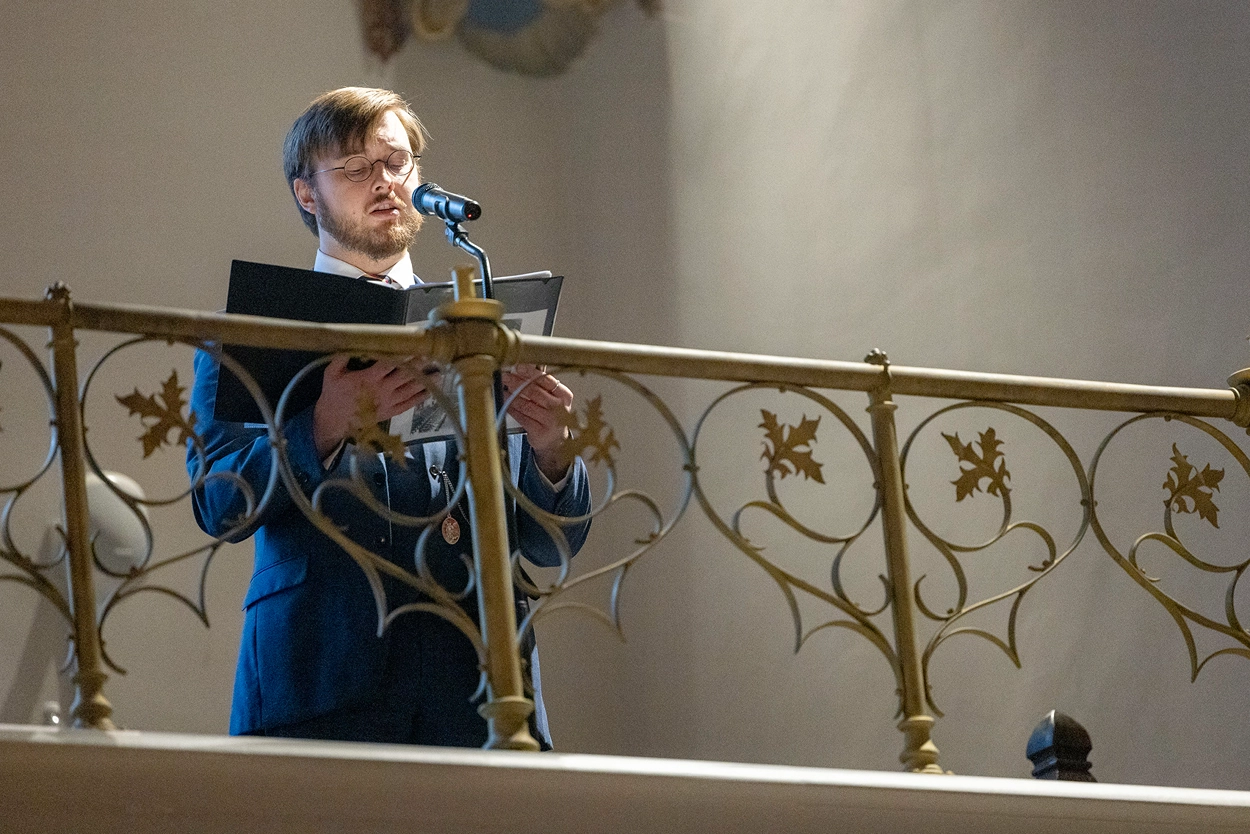

Why does liturgical music matter so much in priestly formation? Fr Craig - who, alongside his work in vocations for the Archdiocese of Birmingham, oversees music at Oscott - reflects on how learning to sing, listen, and serve the liturgy shapes seminarians for parish life.
Fr Craig notices a striking pattern among those discerning priesthood. “Most can understand being still before the Blessed Sacrament,” he says, “but some - especially the younger generation - really struggle with being completely silent in that time.”
It’s not just those discerning their vocation to the priesthood. Silence, for many, feels uncomfortable - almost intolerable. It’s almost a reflex to listen to music, podcasts or other content during commutes or downtime.
So he offers a simple discipline: stay put, set a timer, don’t run away. Not as a test of endurance, but because silence is where something essential happens.
“It allows that moment for the mind and the heart to process things… that moment for God to speak.”
He often gives men one short line from the call of Samuel to pray with: “Speak, Lord, your servant is listening.” And then he adds, humorously, that modern life tends to flip it: “Listen, Lord - your servant is speaking.”
When Fr Craig talks about music in the liturgy, he is very clear about its purpose. “The key to liturgical music is that it’s not about us. It should always be about God and raising our hearts and minds to Him.”
That principle is especially important at a time when many parishes are rediscovering more traditional forms of sacred music - Gregorian chant, sung antiphons, richly theological hymns - alongside newer compositions that are more intentionally catechetical.
This renewed interest isn’t about nostalgia. As Fr Craig puts it, it’s a rediscovery of patrimony - in this case, music that has shaped prayer across generations, which has taken its shape and character from the particular historical context of this country, and still teaches the faith when sung attentively.
“When it comes to hymns, they should help us to praise God and teach us about our faith,” he says. “We’re not singing music at Mass just because it makes us feel good.”
Every week at Oscott, the whole house - seminarians and priests together - gathers for chant practice. They prepare what’s coming in the liturgy, but the deeper work runs underneath.
With twenty-five individual voices, unity doesn’t come naturally. It has to be learned: listening to those beside you, adjusting your volume, letting go of ego. Fr Craig’s rule of thumb is simple and revealing:
“If you can’t hear the person next to you, you’re probably singing too loudly. If you can’t hear yourself at all, you’re probably not singing loudly enough.”
It’s practical advice - and it’s also deeply pastoral. Singing together forms future priests in attentiveness, humility, and communion. These are habits they will carry into parish life, whether they are leading sung prayer or navigating far more complex forms of collaboration.
All of this becomes especially clear in Lent. Fr Craig describes the season as a “stripping back” - of the senses, of anything that doesn’t lead us to God. At Oscott, the music remains, but it is simplified: less organ playing, no flourishes, no unnecessary sound.
“In a sense, we fast musically,” he says, “so that when we get to Easter Sunday, we pull all of those stops out… literally!”
Just as fasting sharpens hunger, musical restraint sharpens joy. When the Gloria finally returns, it does so with force - not because it is louder, but because it has been missed.
This teaches seminarians something crucial: liturgical music is always at the service of the mystery being celebrated. It must never overpower it.
“The music should never be the dominating thing,” Fr Craig says. “It should be at the service of what’s going on.”
The men formed at Oscott will one day serve parishes and communities with very different musical realities. Some will inherit choirs and organists; others will work patiently with small groups and limited resources. But formation doesn’t promise perfection. What it gives is a vision, an expanding of opportunities to give glory to God.
“This is what we’re striving for,” Fr Craig says - not as something to impose, but something to grow towards, step by step, alongside the people entrusted to them. At a moment when the Church is rediscovering the depth and beauty of her musical tradition, and when many are exploring the beauty of God through the beauty of music and liturgy, that vision matters more than ever.